Community-Led Mangrove Restoration in Cambodia as a Nature-Based Solution for Coastal Resilience
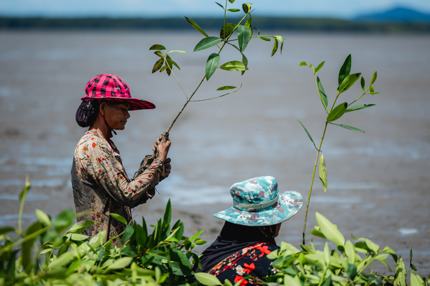
A large-scale community-led mangrove restoration initiative was carried out in Chumpu Khmao Village, Tuol Totoeng Commune, Prey Nop District, Preah Sihanouk Province. Led by the Ministry of Environment, Cambodia, in collaboration with the United Nations Environment Programme (UNEP), the initiative saw the planting of 25,000 mangrove saplings, reinforcing Cambodia’s dedication to protecting marine ecosystems and building climate resilience.
Over 100 participants joined the planting event, including representatives from national and sub-national authorities, community members, teachers, women’s groups, youth, and students. This inclusive approach empowered local stakeholders to take ownership of their environment and served as a practical demonstration of how local action can support global marine goals.
The restoration program directly supports Cambodia’s Circular Strategy on Environment (2023–2028), which commits to reforesting at least one million trees annually. By restoring degraded mangrove ecosystems, the initiative enhances the health of marine habitats that serve as breeding and nursery grounds for important fisheries species. These ecosystems not only sustain biodiversity but also serve as natural coastal buffers, reducing the risks of storm surges and coastal erosion while storing carbon and mitigating climate change.
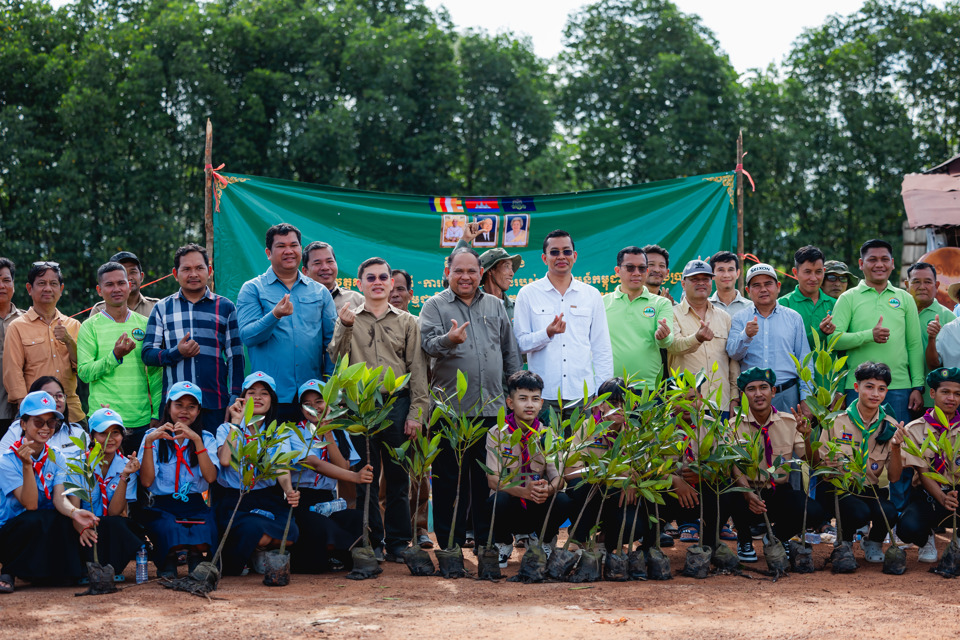
“This planting of 25,000 mangrove trees marks a meaningful step forward in realizing Cambodia’s commitments made at the Third United Nations Ocean Conference and under the Circular Strategy on Environment” said H.E. Kop Roly, Under Secretary of State at the Ministry of Environment. “It supports our vision of a clean, green, and sustainable Cambodia by enhancing climate resilience, promoting reforestation, and supporting local livelihoods. This initiative reflects our dedication to environmental integrity, increasing forest cover, and achieving carbon neutrality by 2050.”
This mangrove restoration activity exemplifies how community empowerment, supported by strong national frameworks and international collaboration, can lead to tangible results in protecting marine habitats. Cambodia’s call for stronger international partnerships and increased financing for nature-based solutions (NbS) underscores the importance of scaling up such efforts globally. By combining grassroots engagement with national and international priorities, Cambodia is demonstrating that local action is essential to global impact, protecting our coasts, our climate, and our future.